The screenwriting app with a desk, a corkboard and a production office
Dreams do come true.
Type your pages, pin every scene to a corkboard and string your plotlines across it in yarn. Then, when somebody says yes, shoot it from the very same script.
Sign up By invitation, with a month free
INT. ORPHEUM THEATRE - BOOTH
The beam cuts through dust. Wren threads the last show by feel.
INT. BASEMENT - NIGHT
Nine film cans. THE LONG WAY HOME. REEL 1.
INT. CITY HALL - DAY
“It’s a building, Ms. Okafor.”
EXT. BEACH - DAWN
The same line of sand. Nobody running.
INT. DINER - DAY
“What’s playing?” “Something nobody’s seen.”
INT. LOBBY - NIGHT
The line goes out the door and around the corner.
- Final Draft in and out .fdx both ways, scene numbers and revision colors included
- Pages that match Industry-standard margins, page breaks and (MORE)s
- Any browser, any size A laptop, an iPad, right down to your phone
- Never trapped PDF, Final Draft, Fountain and Word, any time
The Writer side
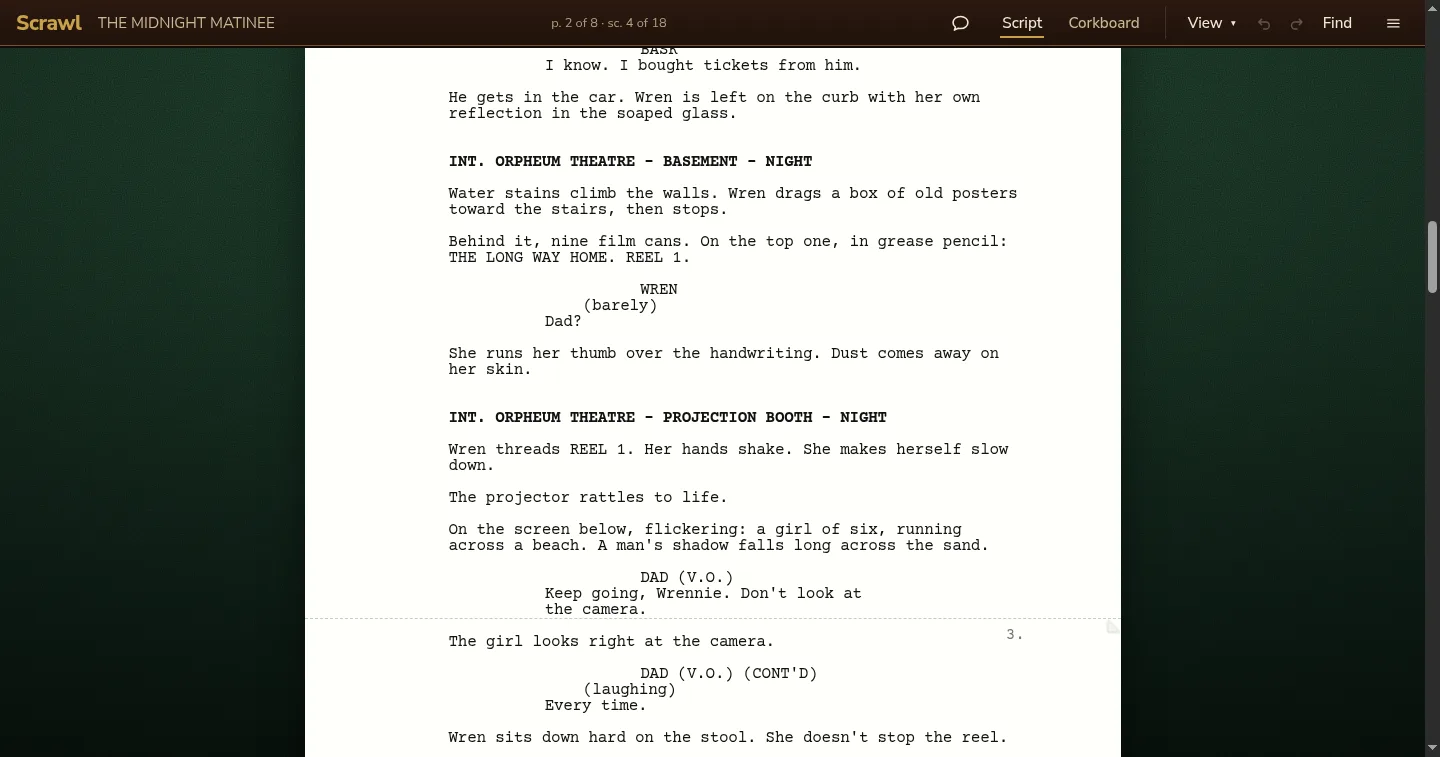
A typed page that’s right the first time
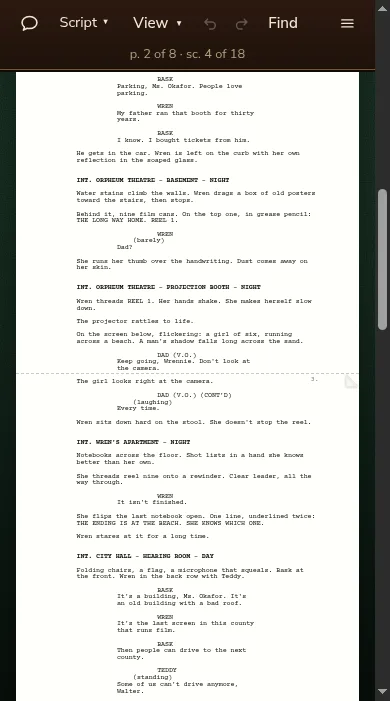
Scrawl types your script the way a reader expects to see it: Courier, the margins every studio uses, scene headings, character cues, dialogue and transitions where they belong. Press Enter and Tab and it knows what comes next. Page breaks fall where Final Draft would put them, with (MORE) and CONT’D at the foot and top of a page, so the page count you see is the one they’ll see.
Where you are sits quietly in the bar, page 12 of 98, scene 14 of 54, and nothing else gets in the way of the words.
Sign up By invitation, with a month free
Typed when you mean business. A legal pad when you’re dreaming.
Same script, same words, one switch. Turn the page over and the scene is written out by hand on yellow ruled paper, for the days a blank Courier page is too loud. Try it:
INT. ORPHEUM THEATRE - BASEMENT - NIGHT
Water stains climb the walls. Wren drags a box of old posters toward the stairs, then stops.
Behind it, nine film cans. On the top one, in grease pencil: THE LONG WAY HOME. REEL 1.
WREN
(barely)
Dad?
The corkboard
Your whole story, pinned up where you can see it
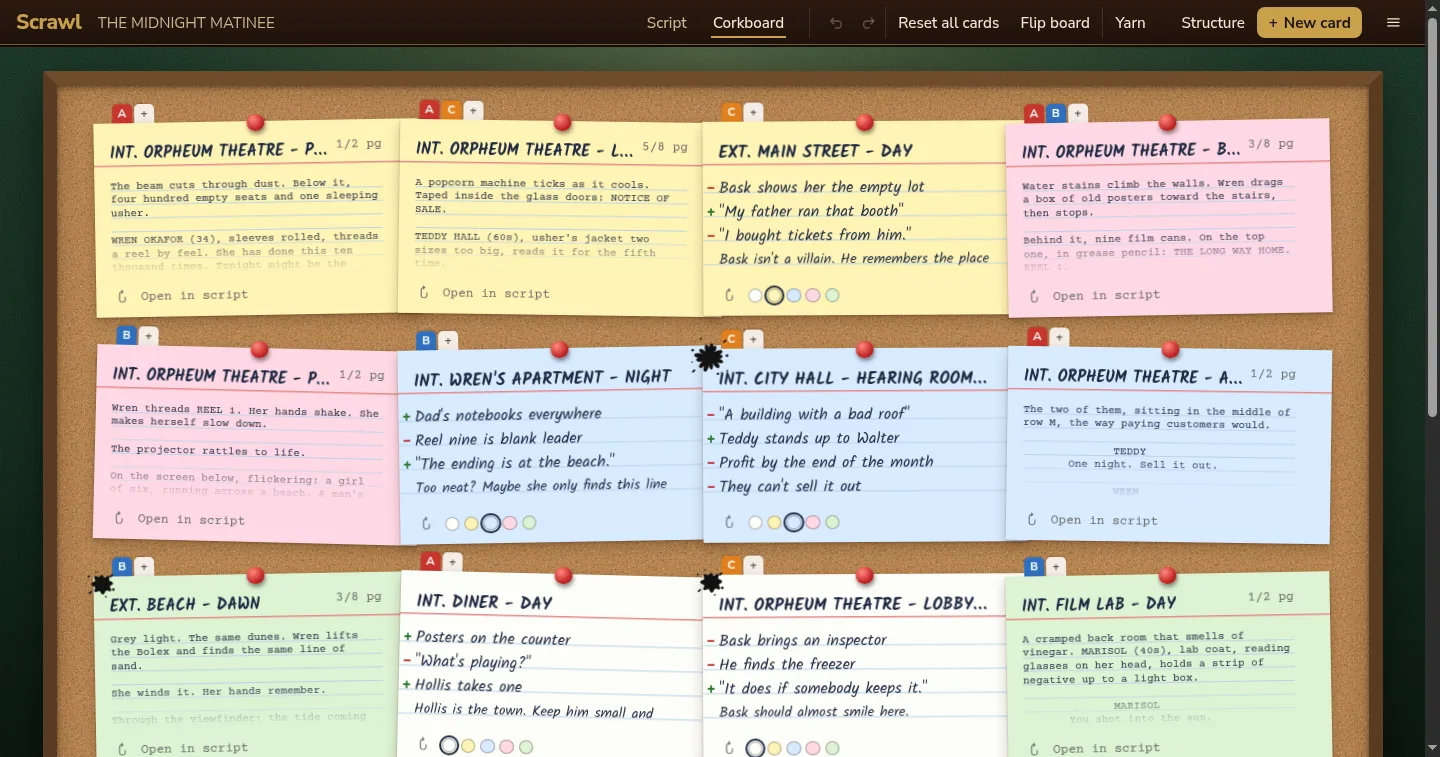
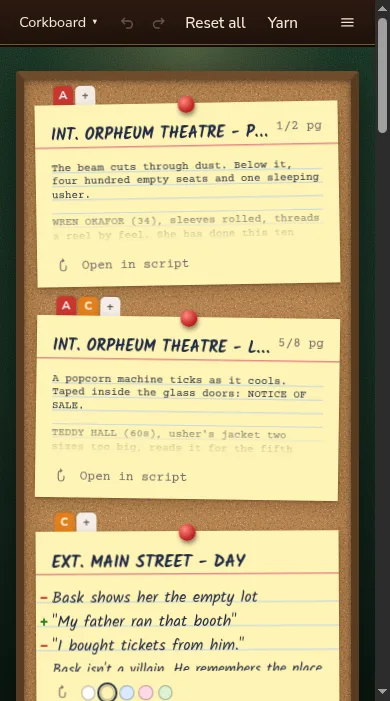
Every scene is a 3×5 card, colored however you think: by act, by sequence, by whose story it is. Drag a card and the script moves with it. Write on the front and it’s the scene’s own words, ready to edit right there on the board.
Flip it over
The back of every card holds its beats and your notes to yourself. Flip one card, or the whole board at once, and plan the story without the dialogue in the way.
Charge every beat
Mark each beat up or down, plus or minus. A good scene swings. Two in a row the same way and the card gets an ink splat, so the flat spots show from across the room.
Bring one up close
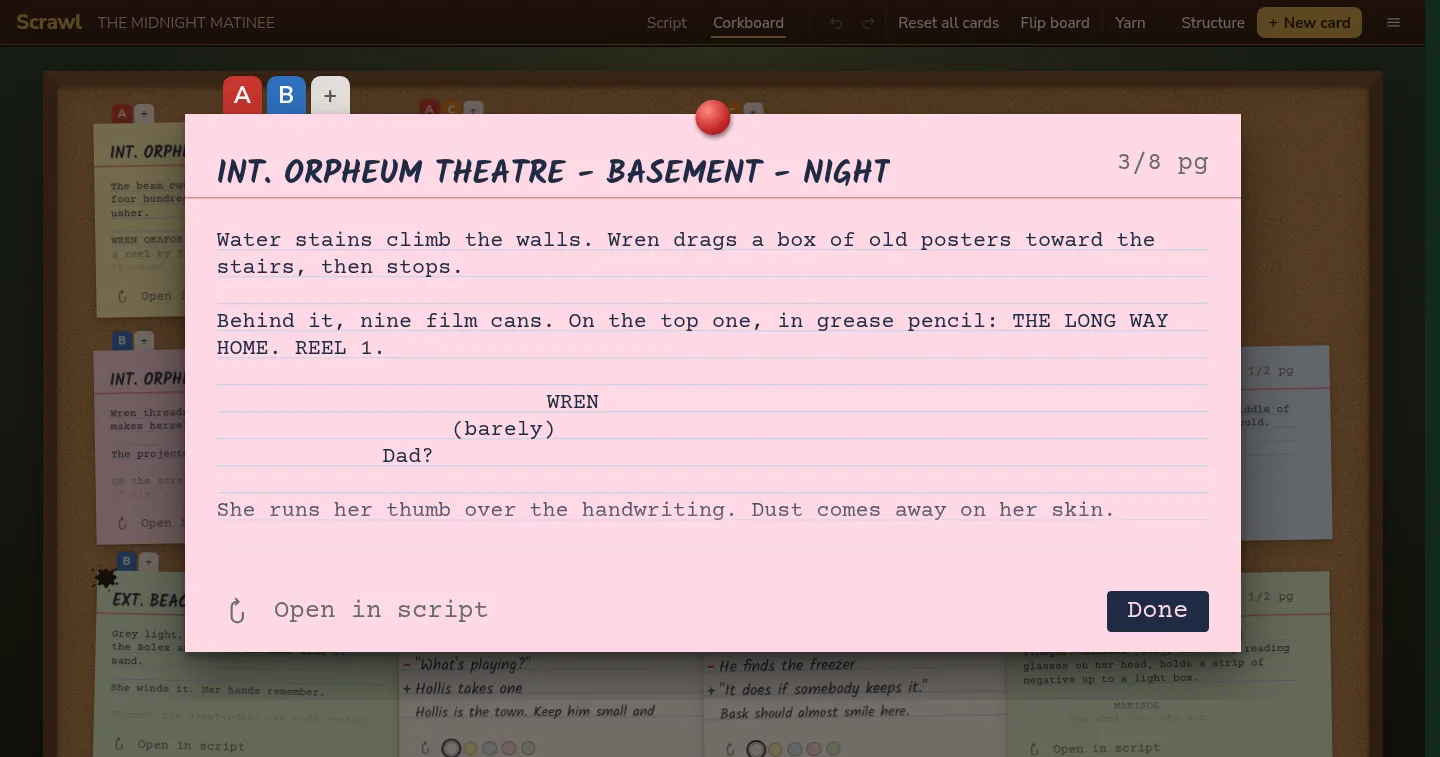
Tap a card and it comes up off the board, big enough to write the scene in, with its page length in the corner. Put it back and it drops onto its pin.
Sign up By invitation, with a month free
Pull one thread
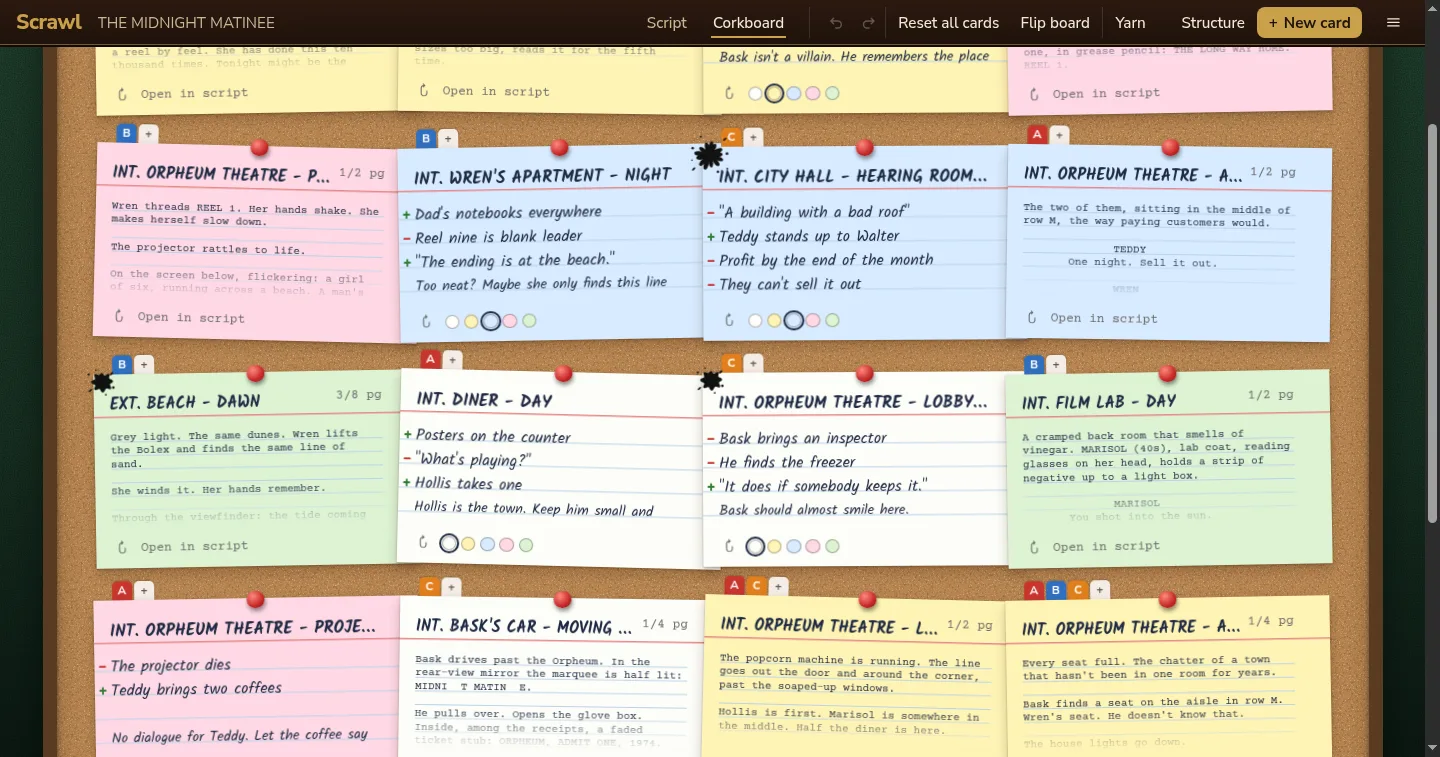
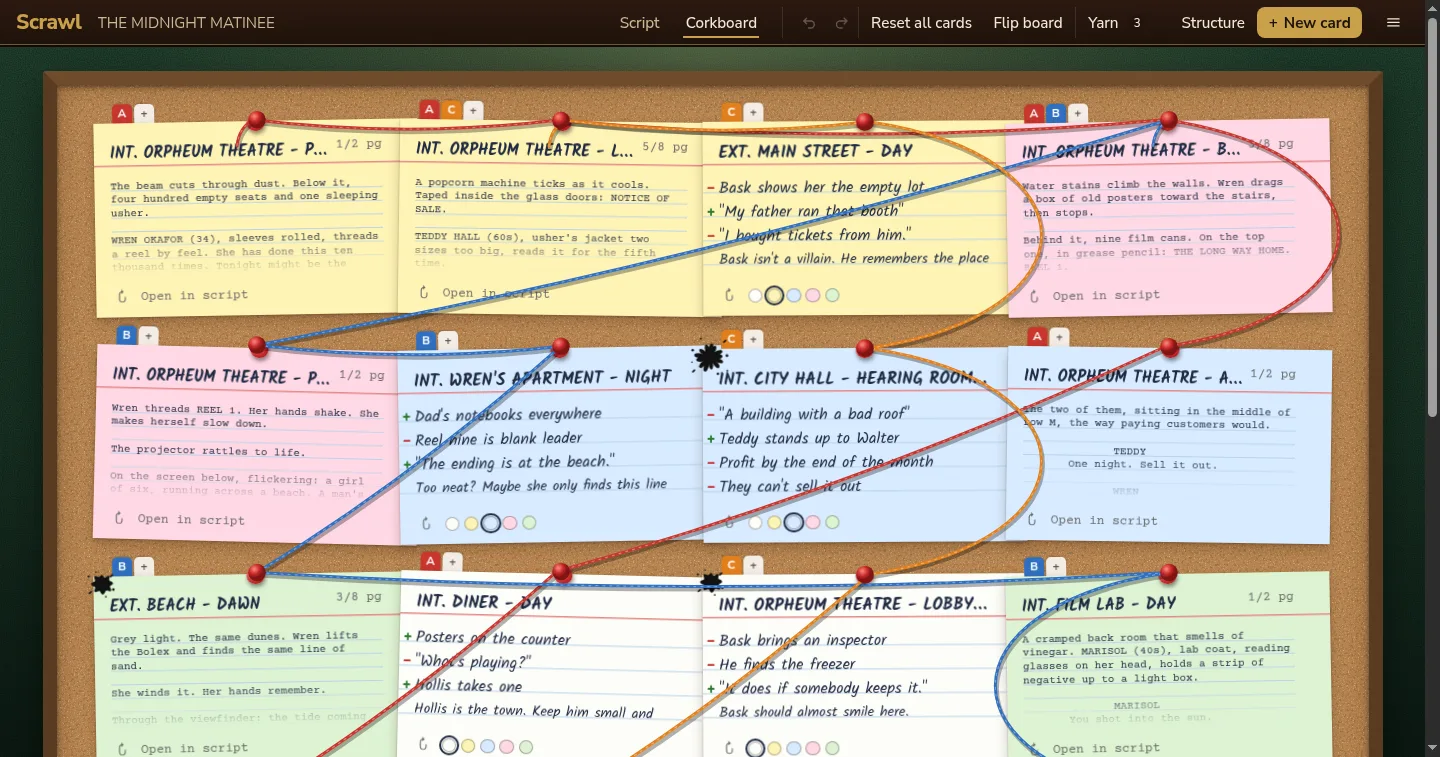
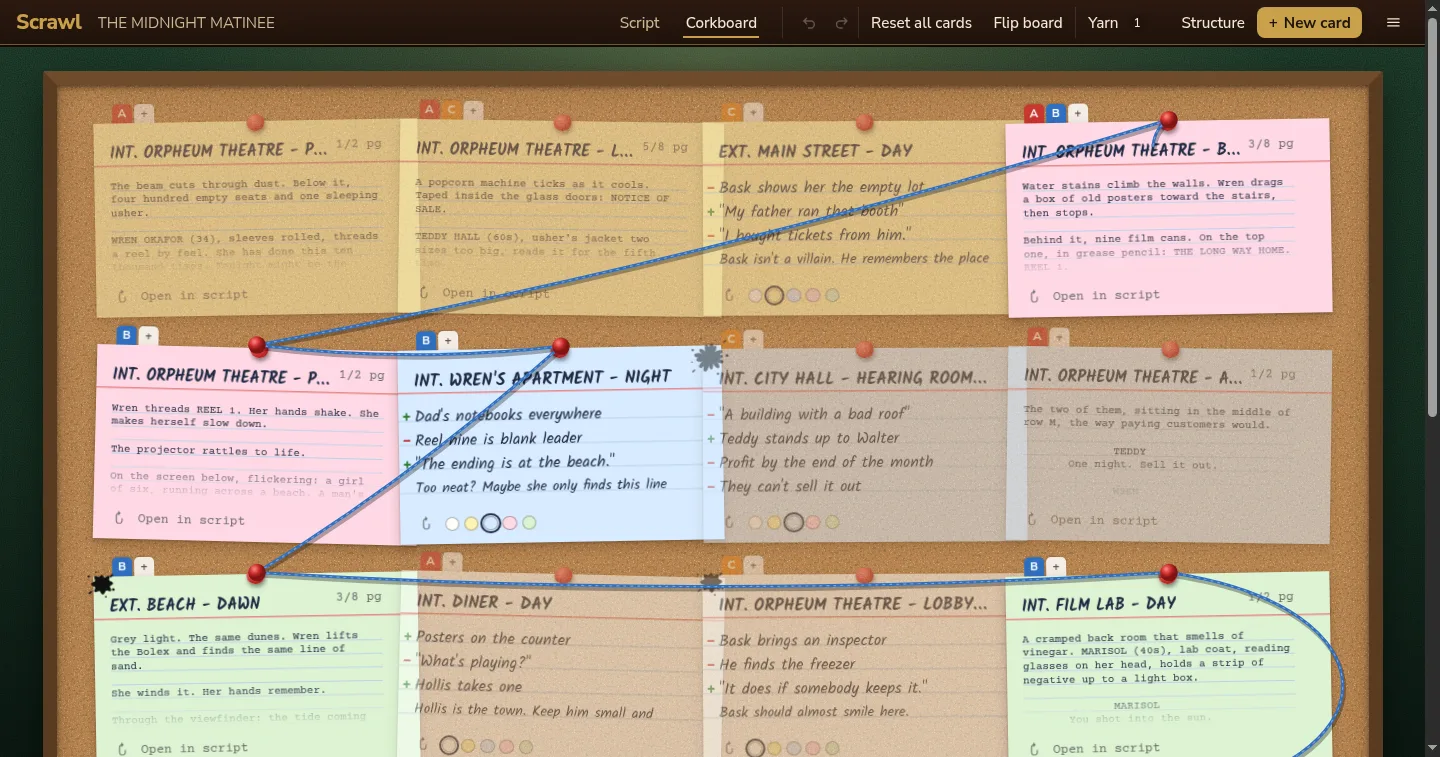
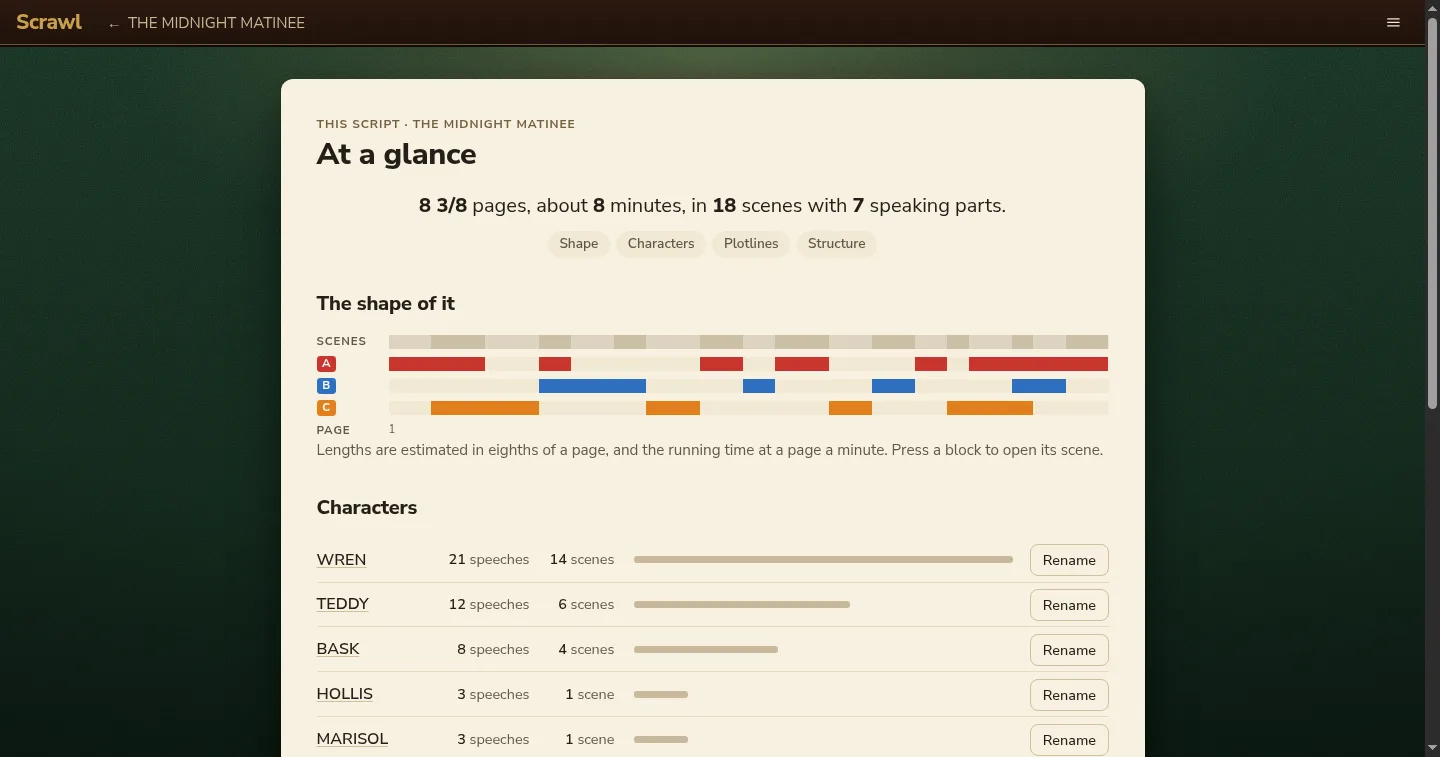
Give each plotline a letter and a color: the A story, the B story, the runner. Then string it across the board in yarn, pin to pin, in script order. Pick one and every other scene falls back into shadow, so you can see where a story sags, where it disappears for forty pages, and where two of them finally meet.
The yarn plays out from the first card to the last when you pick it, then lies still. It’s the kind of thing you’d do with real yarn if your wall were big enough.
Sign up By invitation, with a month free
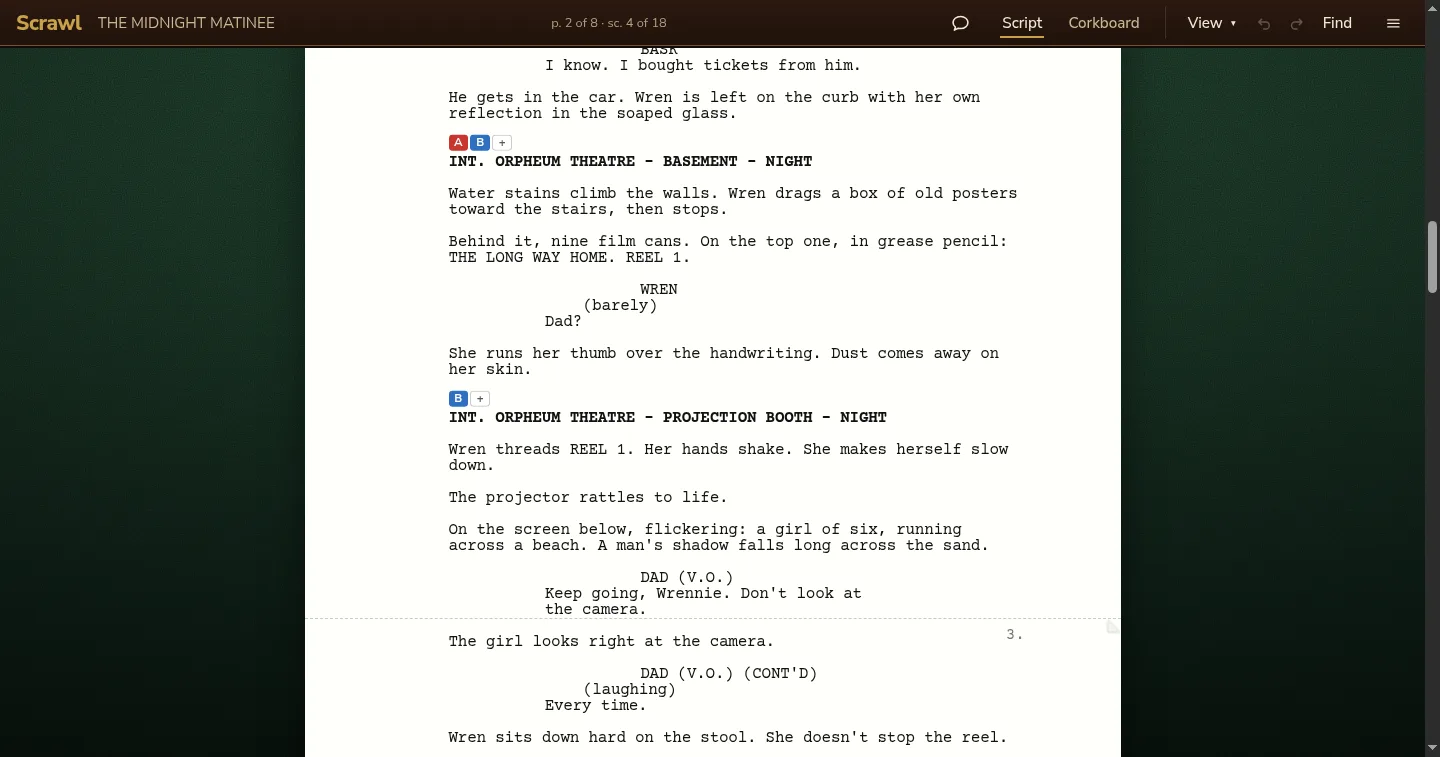
The same threads, in the script
Each scene carries its plotlines’ letters just above its heading, in their colors. Tap them to weave a scene into a story or out of one, and the yarn on the board moves with it.
They’re on your screen, never on the page: the PDF and the Final Draft file go out clean.
A quiet room to write in
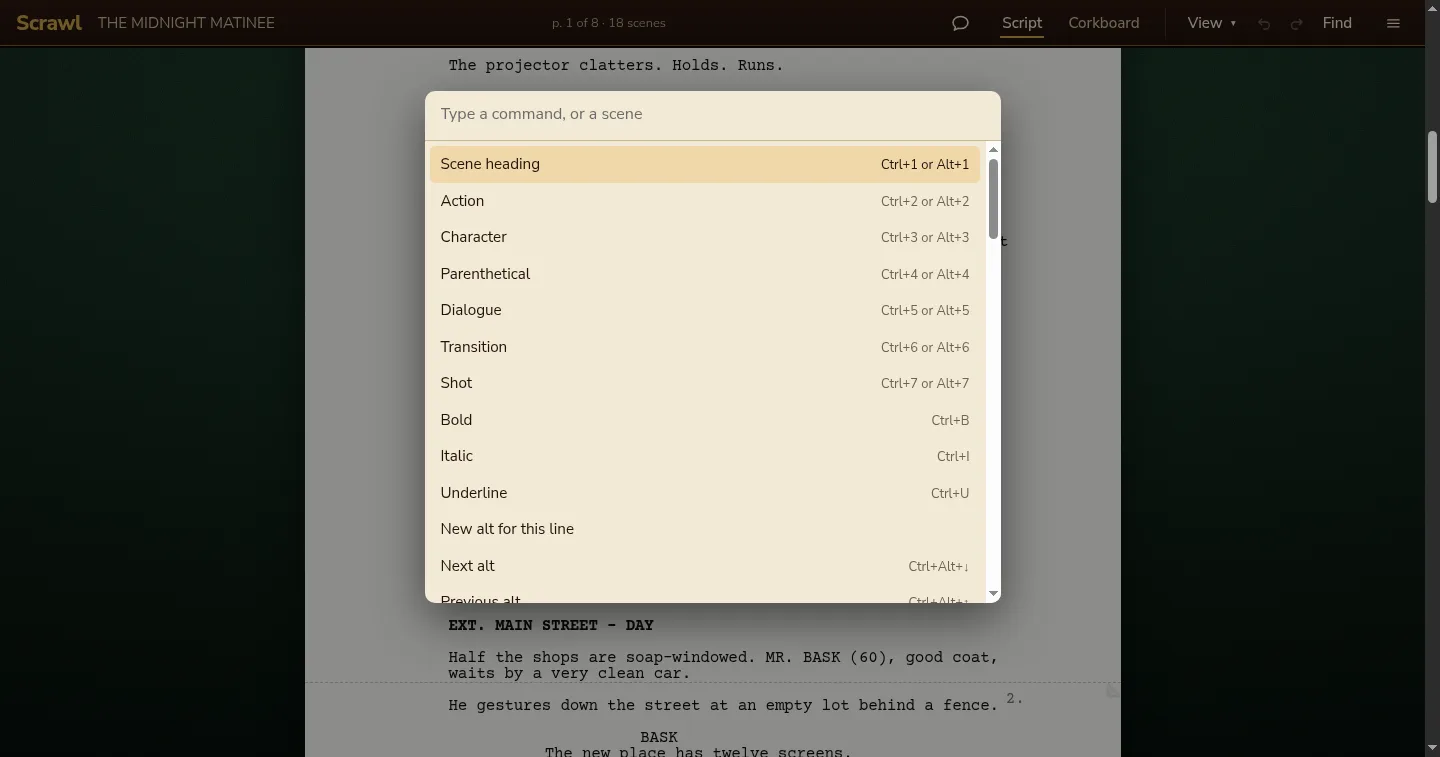
Focus mode leaves you and the words: the bar slips away, and everything but the words goes quiet. Keyboard shortcuts work the way your fingers already expect, and ⌘K finds any command, scene or page.
It goes where you go, too. Open the same script on an iPad on the couch or on your phone in a queue; it keeps writing with no signal and saves the moment you’re back.
Sign up By invitation, with a month free
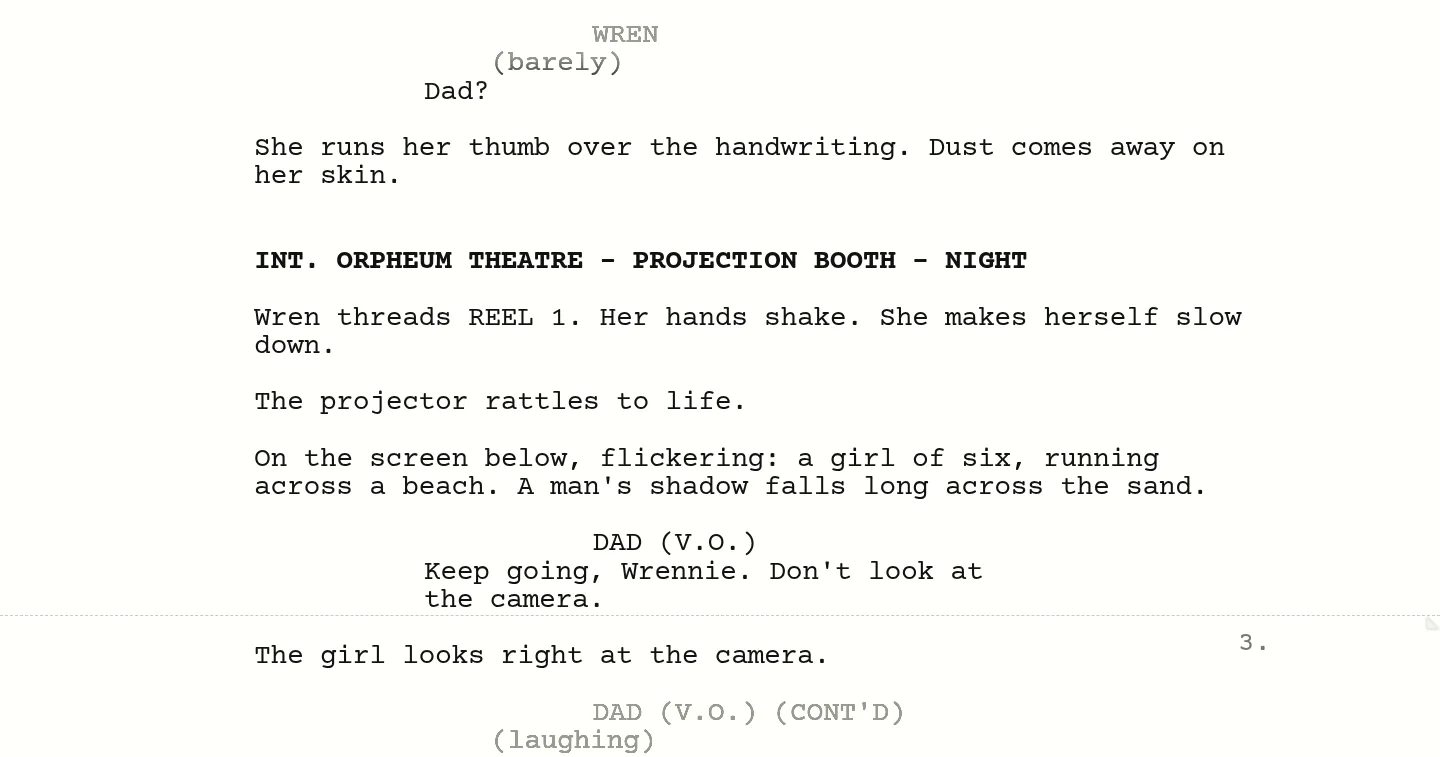
Notes in the margin
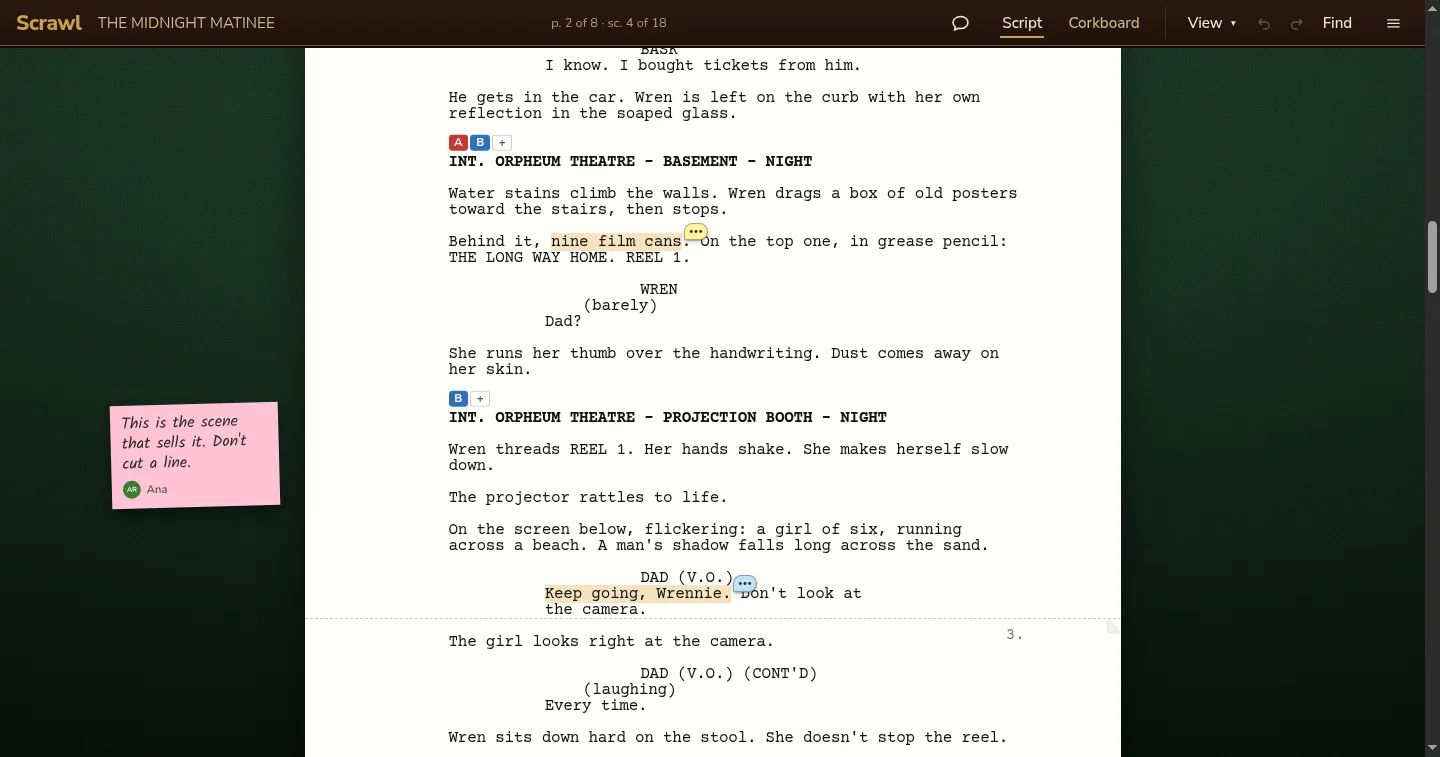
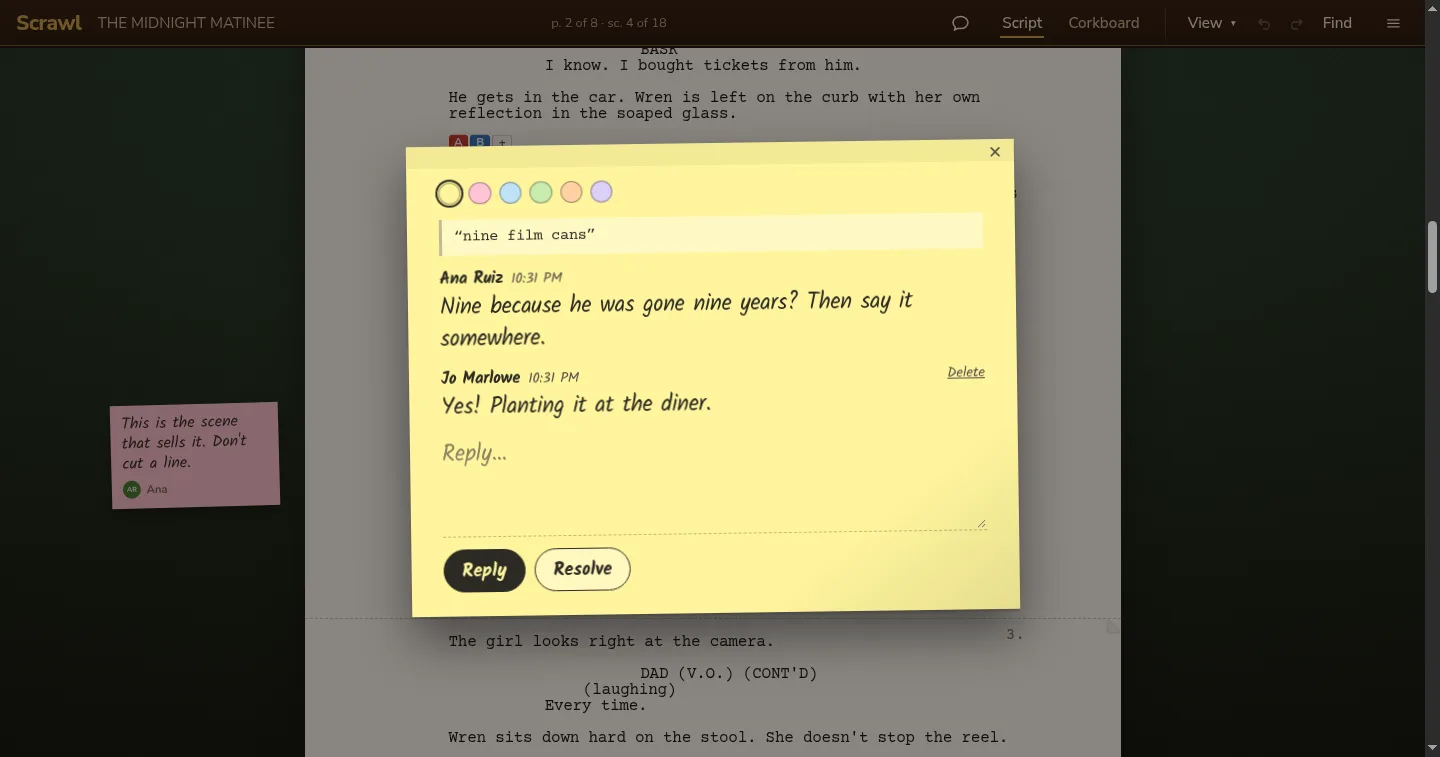
Pick out a few words and leave a note on them, on a post-it in whatever color you like. A note on a whole scene sticks beside its heading. Notes to yourself, or back and forth with a co-writer, and the script itself stays clean.
Writing at two in the morning?
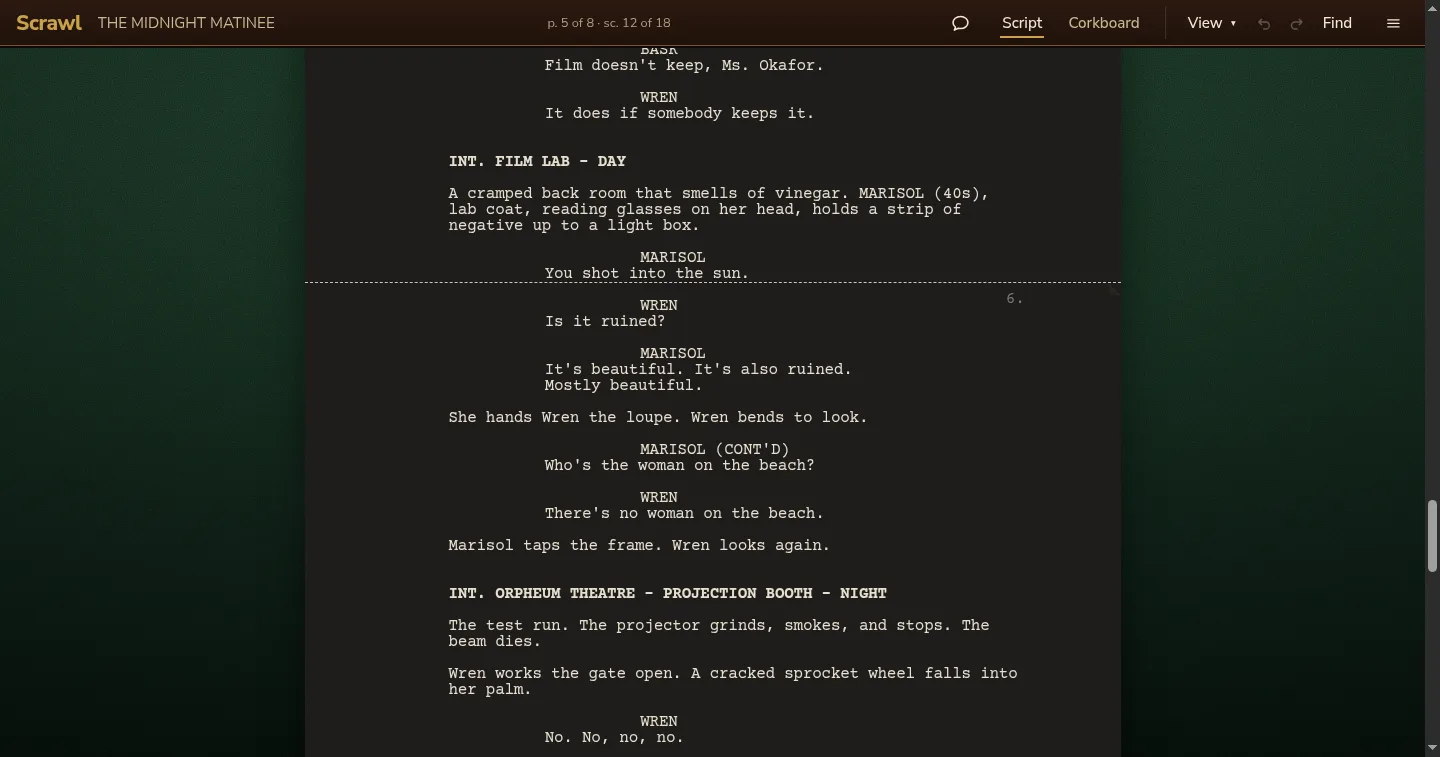
Turn the lamp down. Night keeps the desk and the cards, and turns the pages and sheets dark with warm ink, easy on the eyes when the rest of the house is asleep. Pick it on each device: night on the laptop, day on the iPad.
Every script you’re working on, on one desk
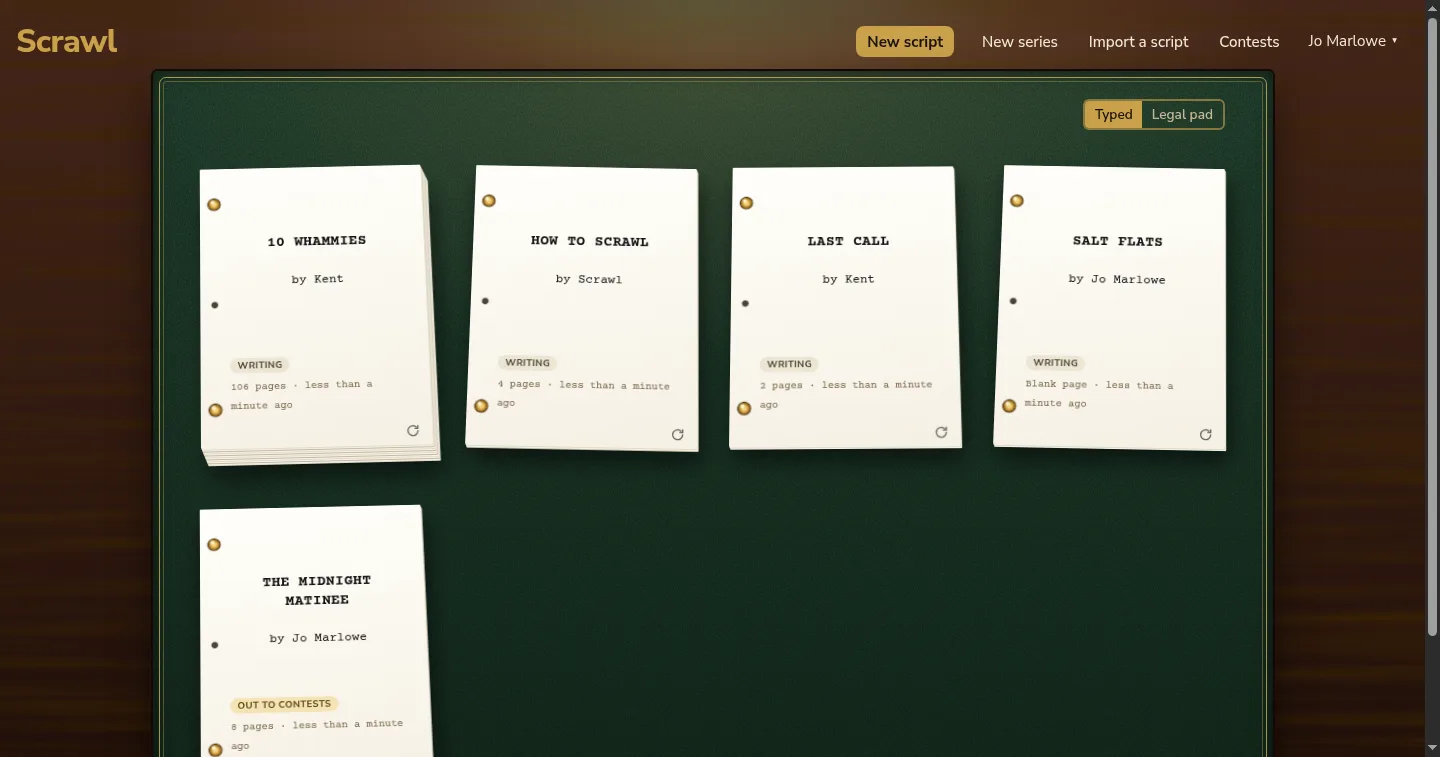
Your scripts lie on the desk as bound copies, brads and all, each as thick as it runs, with a tag saying where it stands: still on the corkboard, being written, out to contests, in production. Series keep their episodes together. Drafts are kept as you go, so you can look back at last Tuesday’s version or put it back.
Sign up By invitation, with a month free
Sending it out
Ready when the reader is
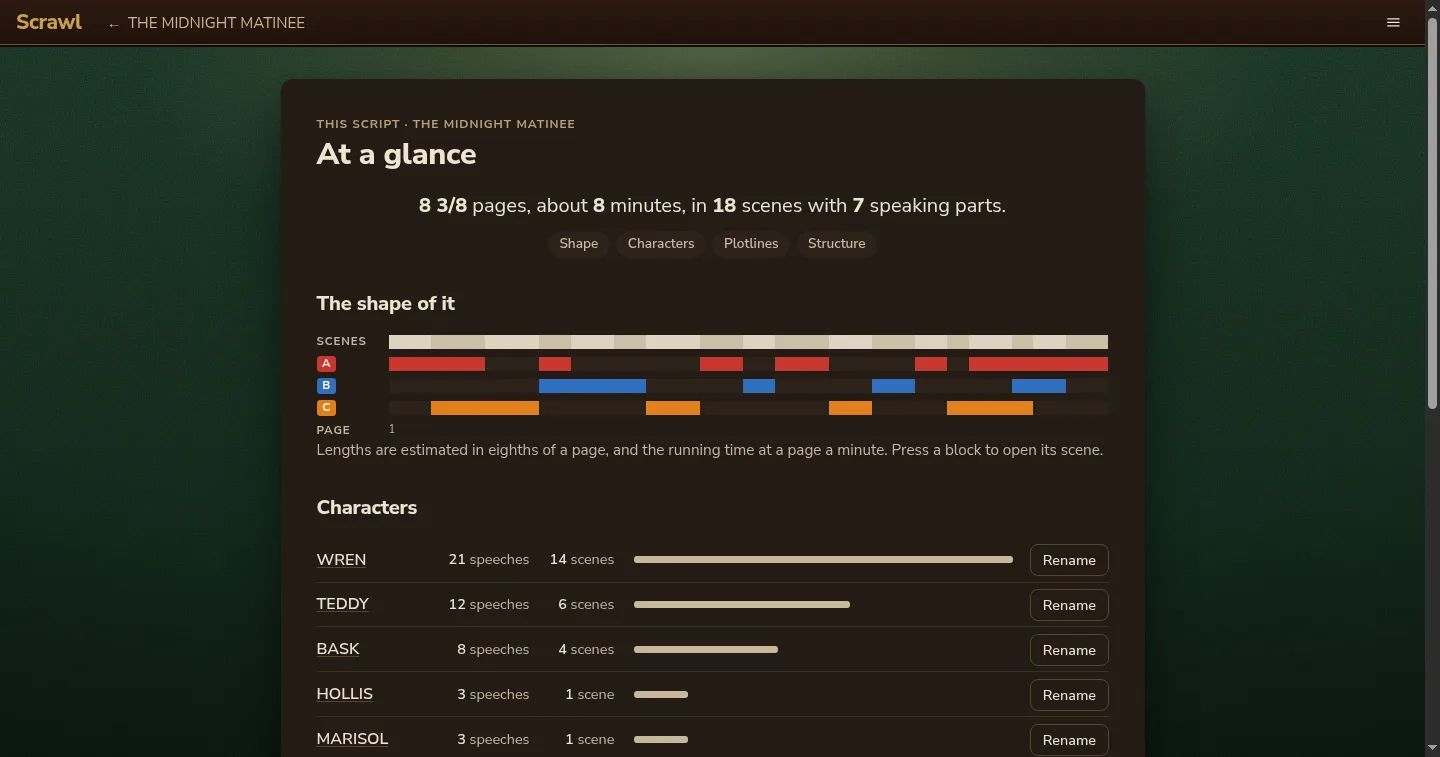
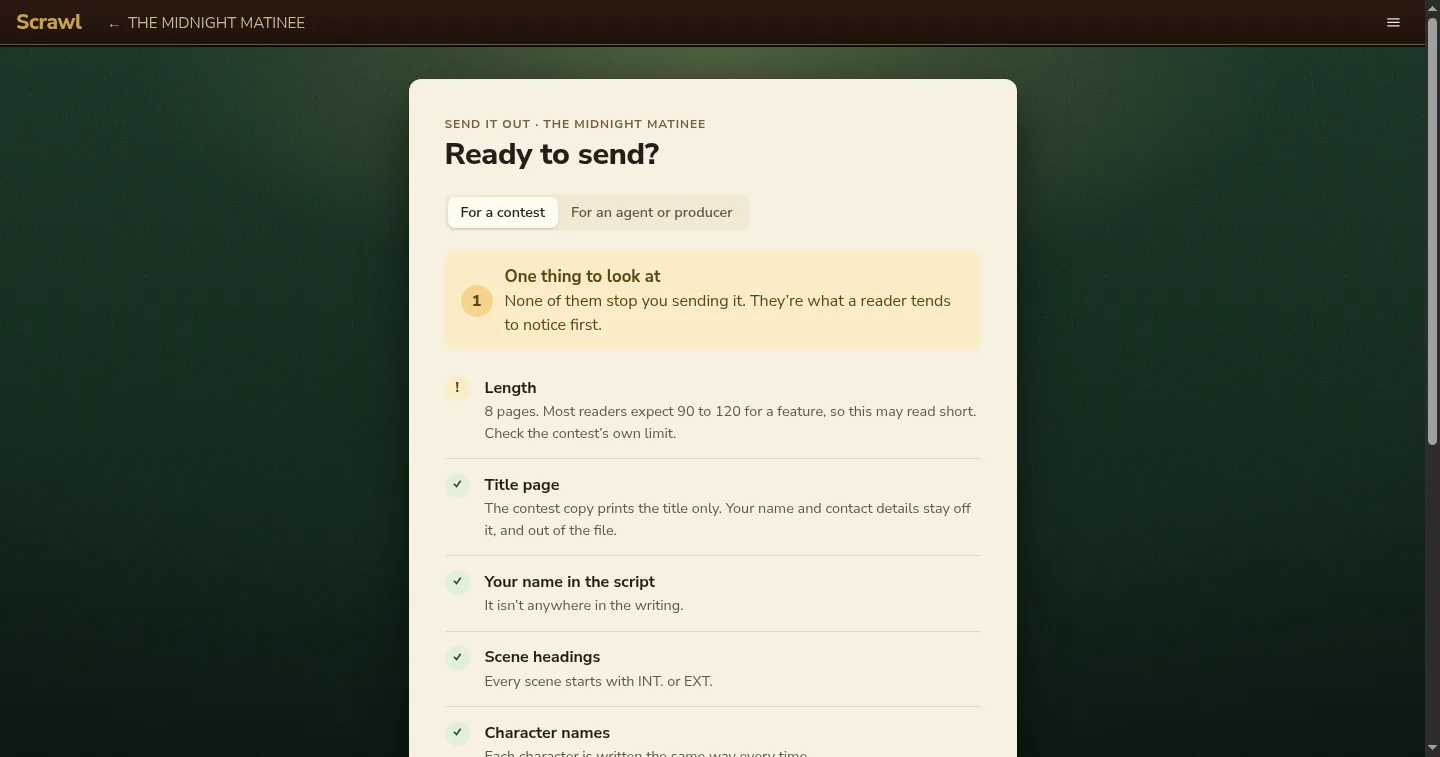
Before a script goes to a contest, an agent or a producer, Scrawl reads it the way a first reader will and tells you what they’ll notice: a page count that’s long for the format, a heading that won’t read, a name spelled two ways, action that runs past four lines. Kindly, with the line it means, and only what’s worth a look.
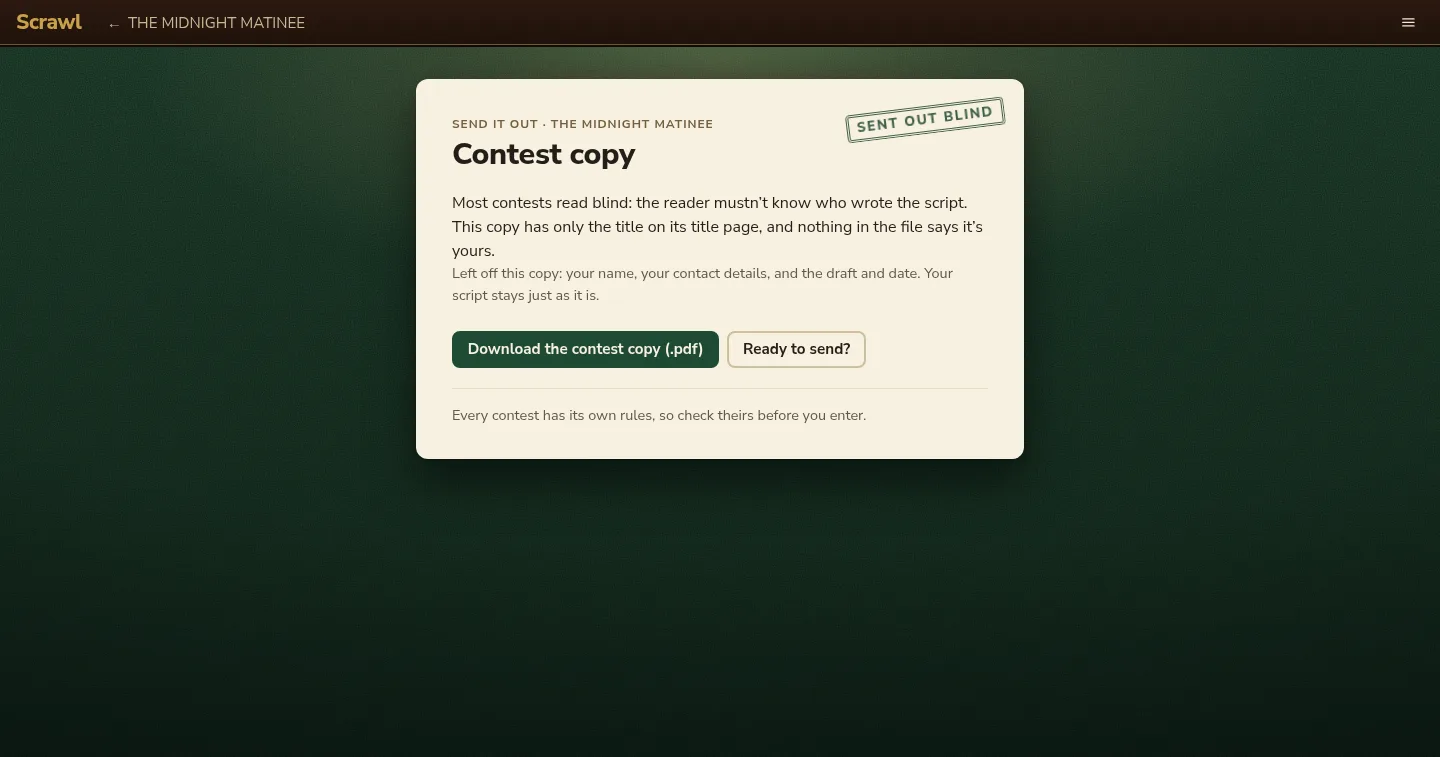
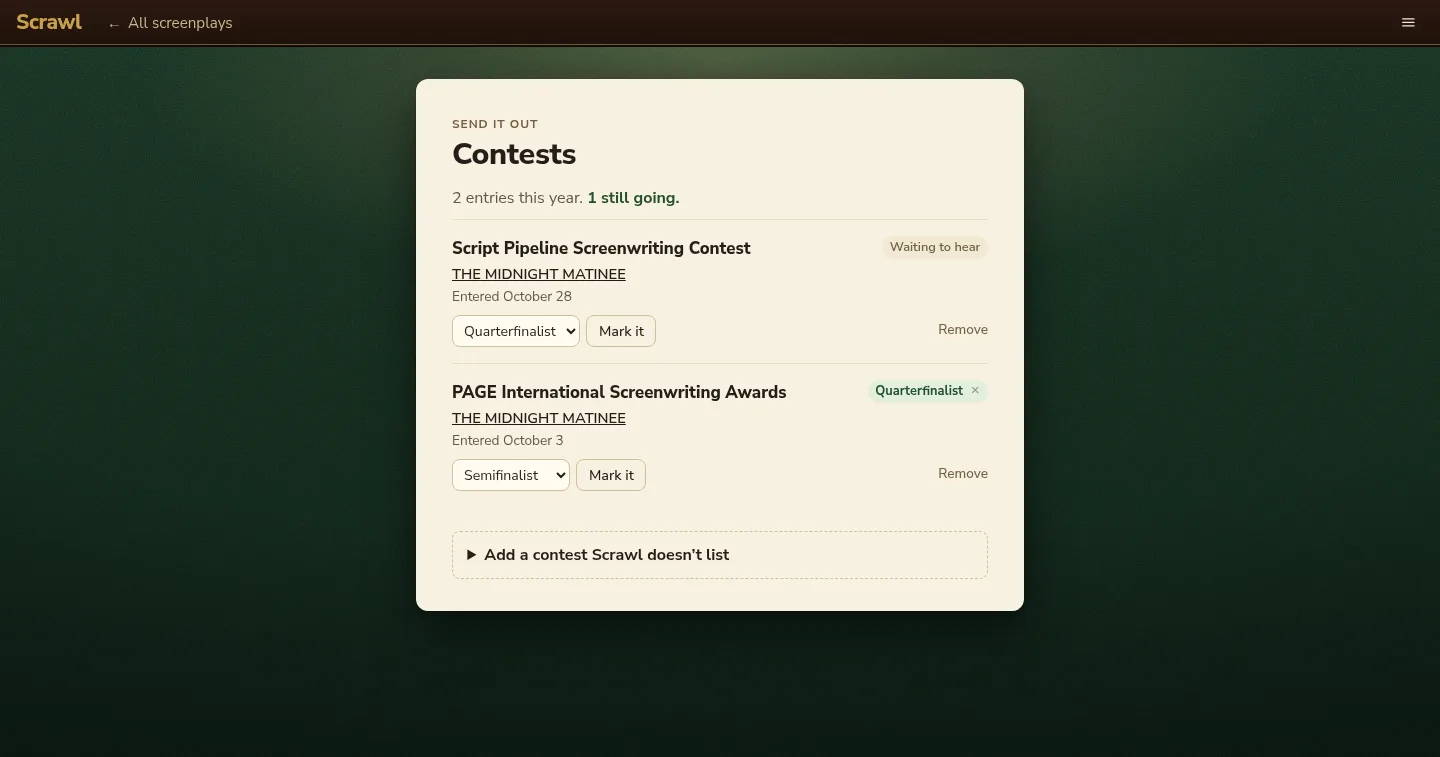
Share a read-only link with someone who doesn’t use Scrawl, watermarked with their name, and see when they open it. Or invite a co-writer to write with you.
Sign up By invitation, with a month free
Then somebody says yes
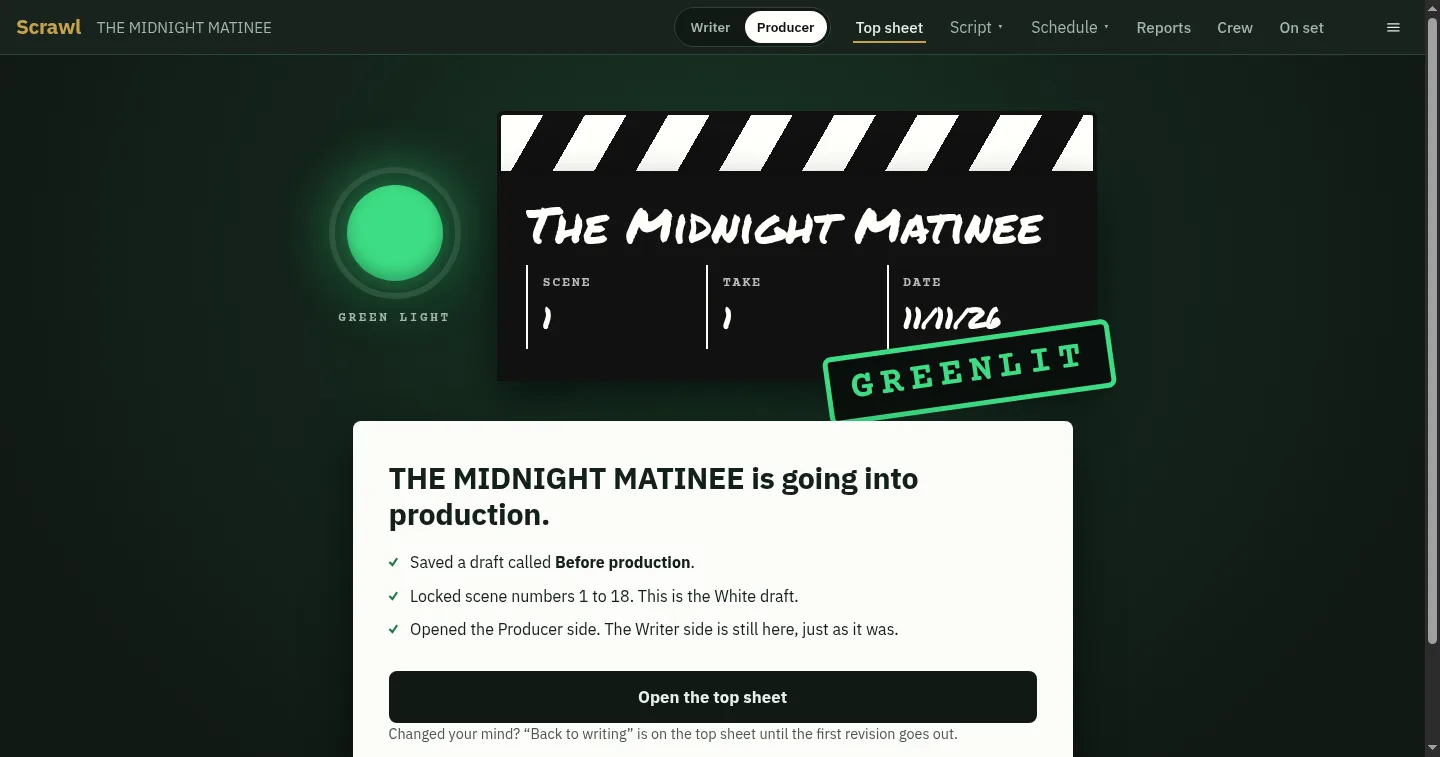
Greenlight.
One button, and the same script is a production. No export, no import, no second copy drifting out of date. Scene numbers lock, the pages go out as the White draft, and the Producer side opens with the script already broken down by scene.
- Read it as a producer. Before you say yes, Scrawl reads your own script back to you as a producer would: pages, running time, locations, night and day, and roughly how many shoot days at your pace.
- Say yes. The greenlight keeps the script as it was, locks the scene numbers and opens the Producer side. Changed your mind? Back to writing, until the first revision goes out.
- Keep writing. The writer keeps writing in the same script. Changes wait as the next revision until the producer issues them in that revision’s color.
The Producer side · coming early 2027
A production office built on the script
Most productions run on a script in one app, a schedule in another, a breakdown in a spreadsheet and new pages in somebody’s email. Every one of them a copy, every copy a little wrong.
In Scrawl they’re all the same script. Change a line and the breakdown, the stripboard, the sides and the reports know about it, and the people whose scenes it touches hear about it when the pages go out.
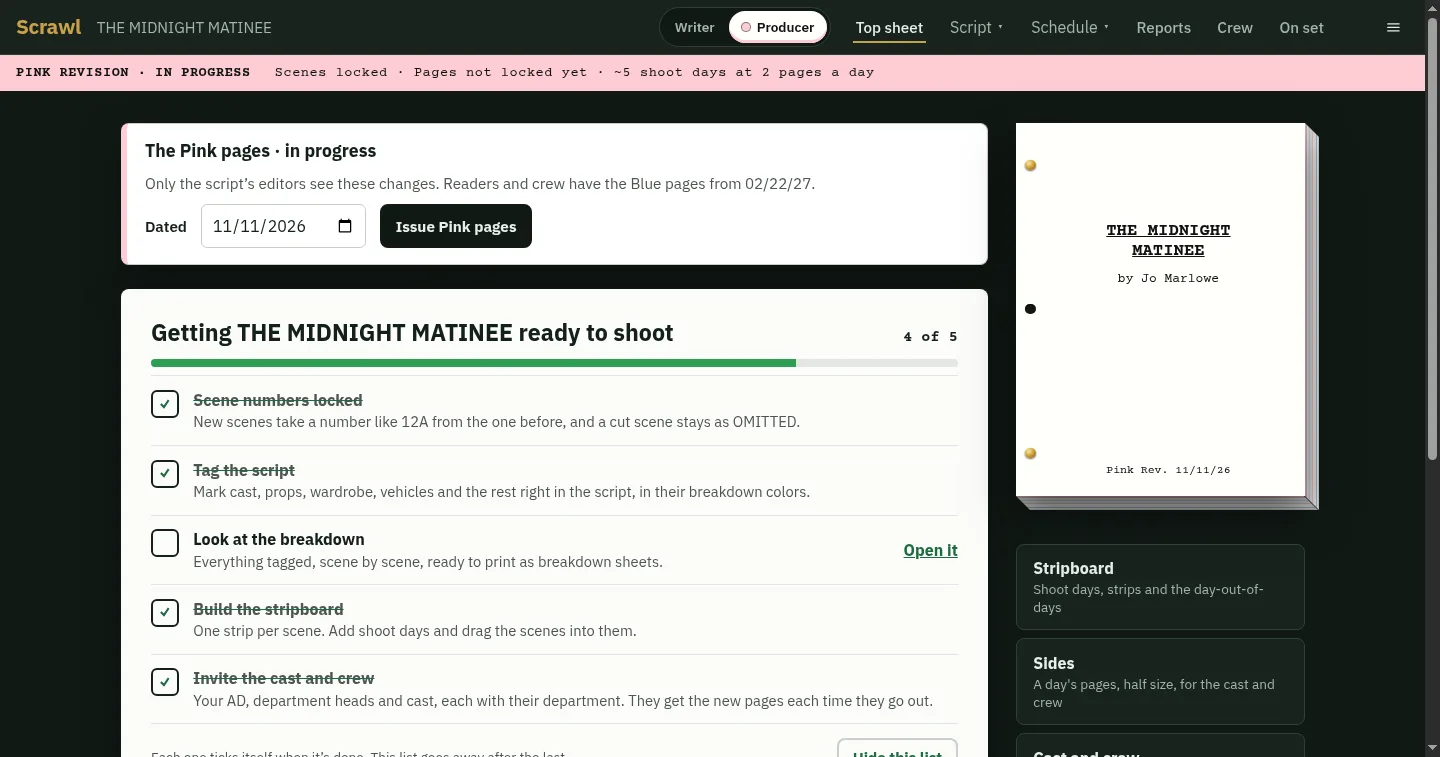
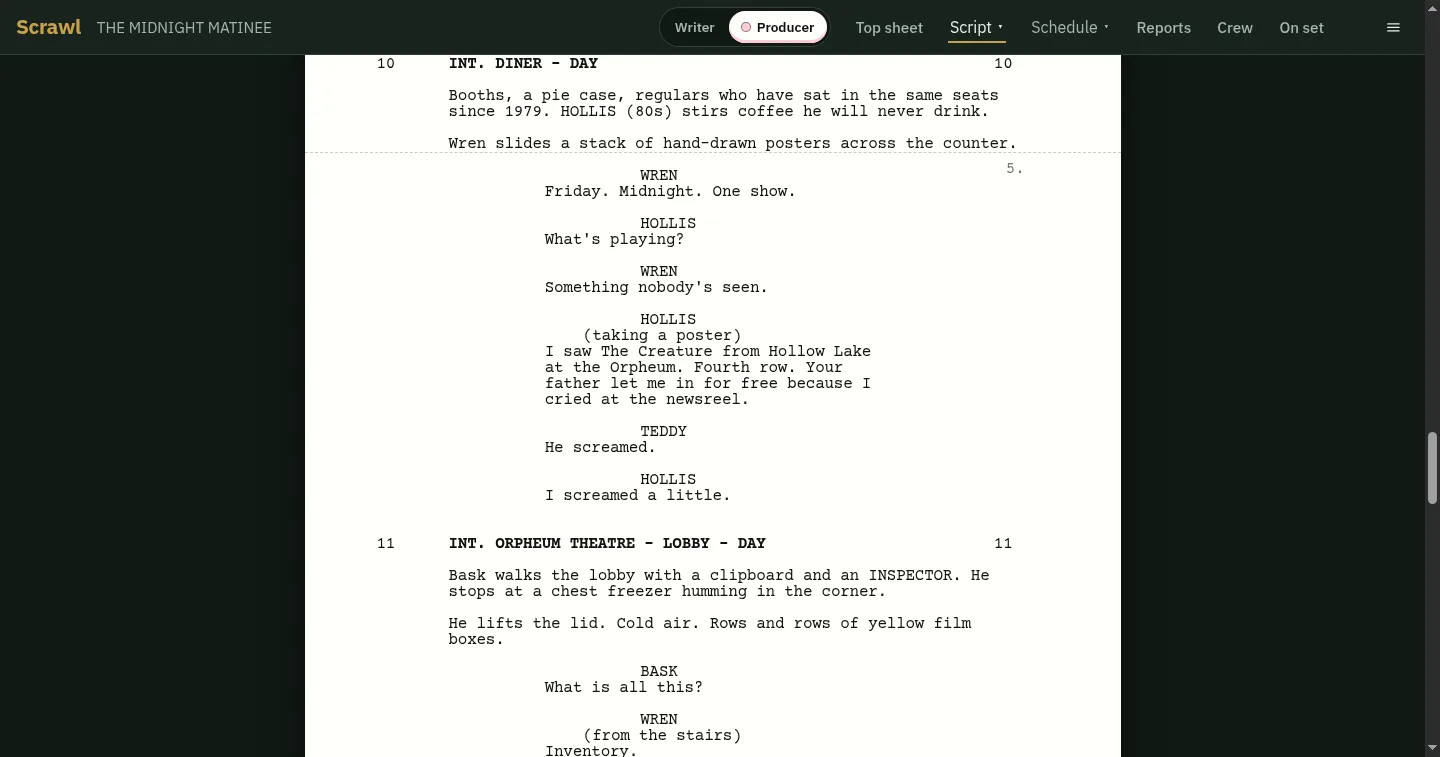
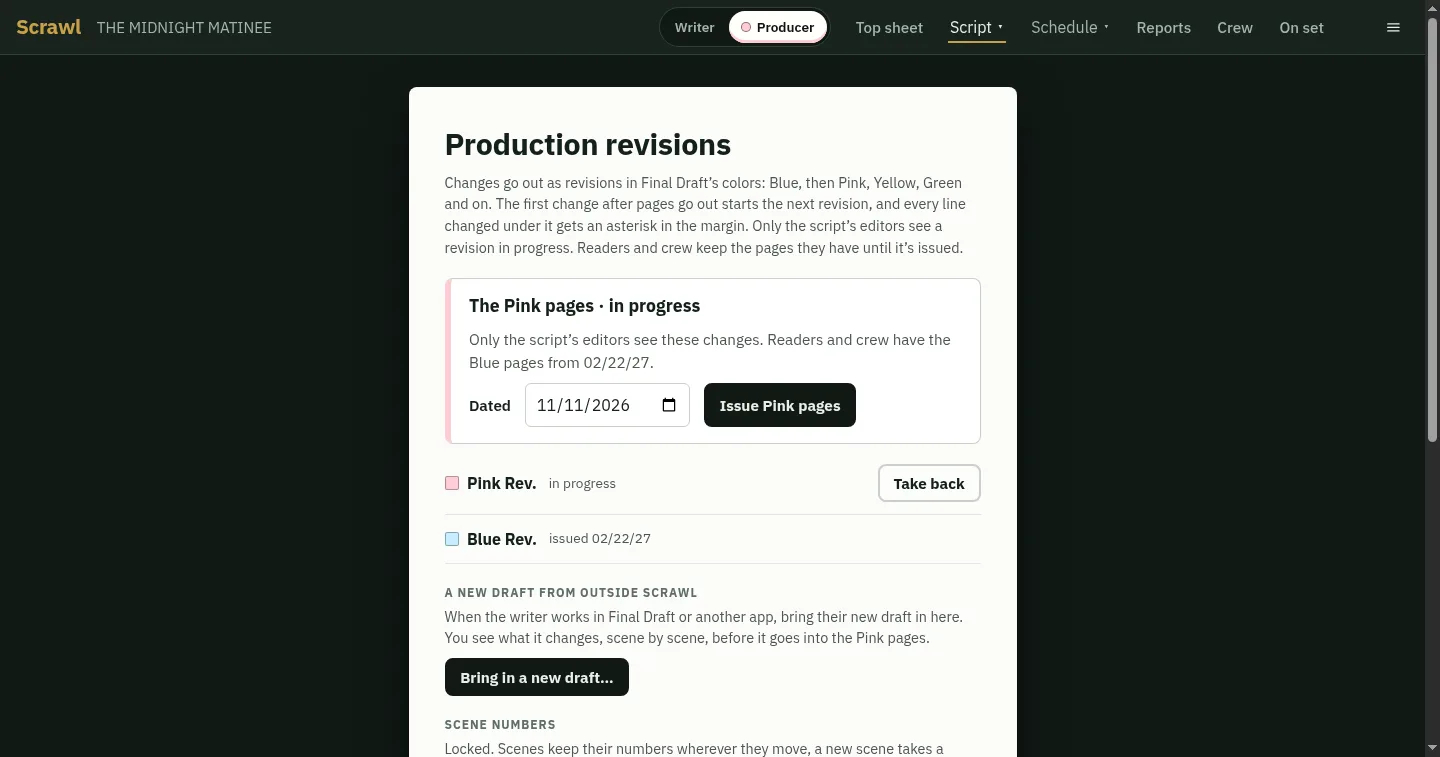
Revisions in their colors, the way a set expects them
White, Blue, Pink, Yellow, Green, Goldenrod: each round of changes is marked with asterisks in the margin and headed in its color, on locked pages that keep their numbers (12A, 12B) so nobody’s copy goes out of order. Readers only ever see issued pages; changes in progress wait until you send them.
A stripboard in the colors every AD knows
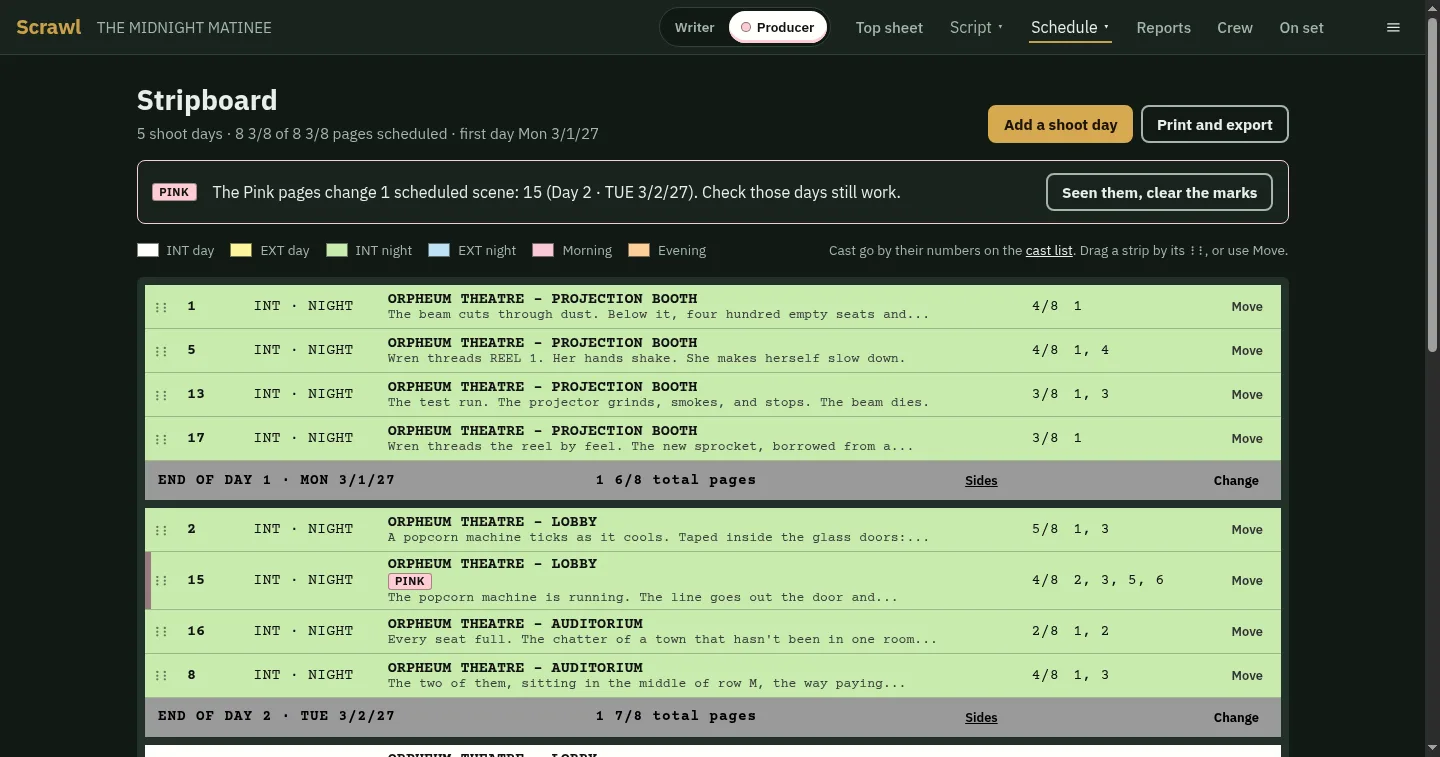
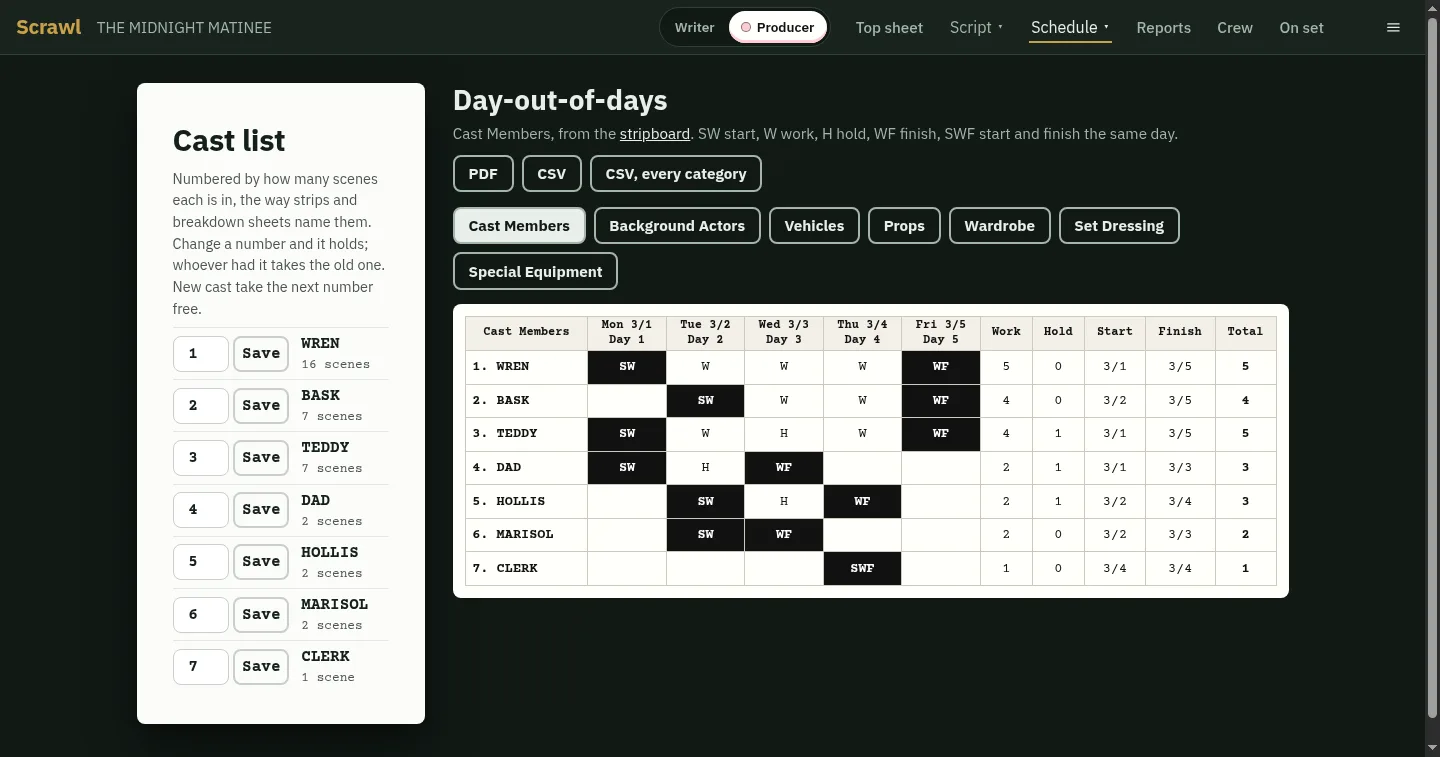
Each scene is a strip, in Movie Magic’s colors: white for day interiors, yellow for day exteriors, green and blue for night. Drag them into shoot days, and the day-out-of-days works out who works when. When a revision touches a scheduled scene, its strip gets a flag in the revision’s color.
Breakdown by tagging
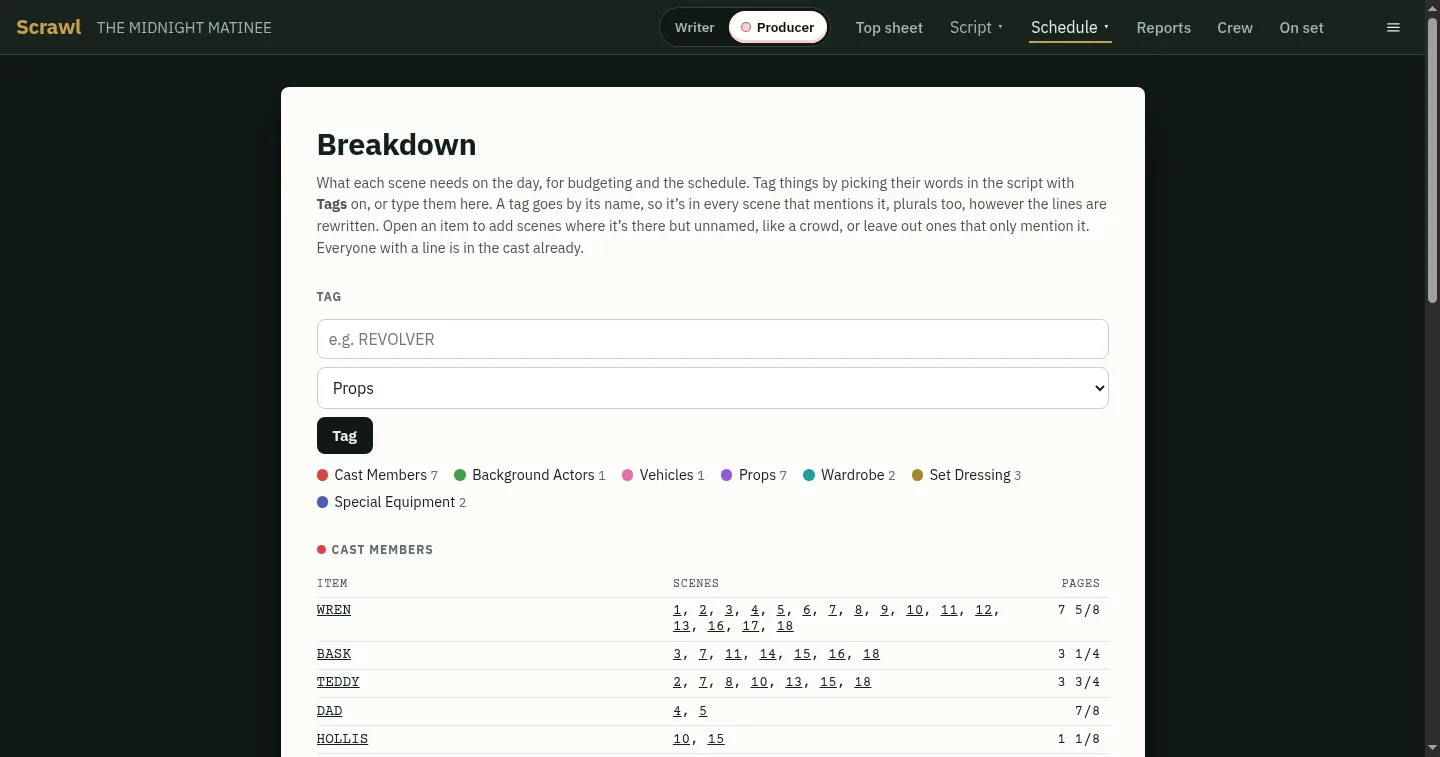
Tag a prop, a car or a costume once by name and it’s in every scene that mentions it, however the lines around it change. Breakdown sheets print in Final Draft’s categories, in the traditional colors.
Sides for the day
The day’s pages, half size, two up, in shooting order, with the scenes not being shot struck through and an actor’s lines highlighted. One button.
Reports that answer money questions
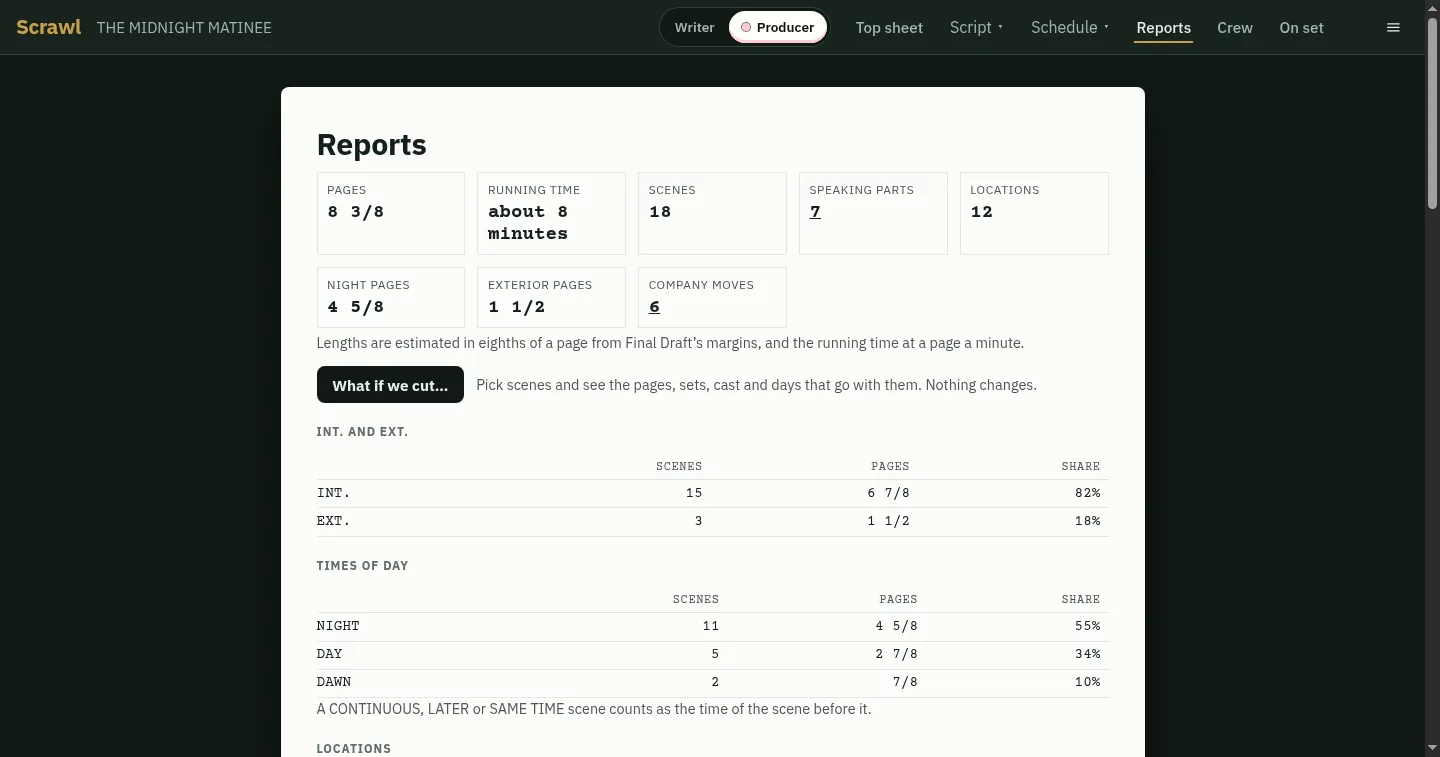
Night pages, exterior pages, places, company moves, cast days. And What if we cut, which shows what a cut would save without touching the script.
New pages, to the right people. And on set, no signal needed.
Invite the cast and crew by department, the way a call sheet lists them. When a revision goes out, each of them gets an email that says what changed in their scenes, with a link to pages watermarked with their name. The top sheet shows who hasn’t opened theirs yet.
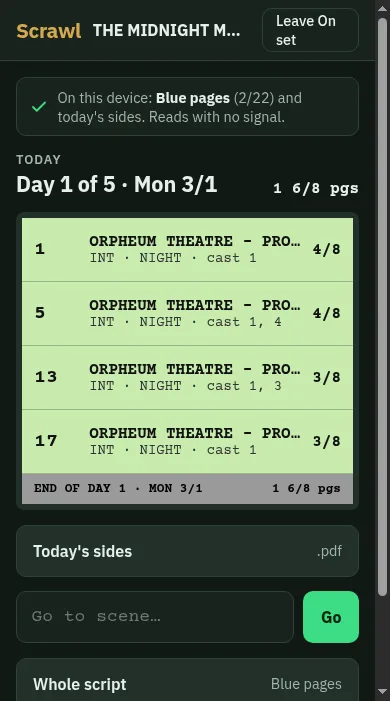
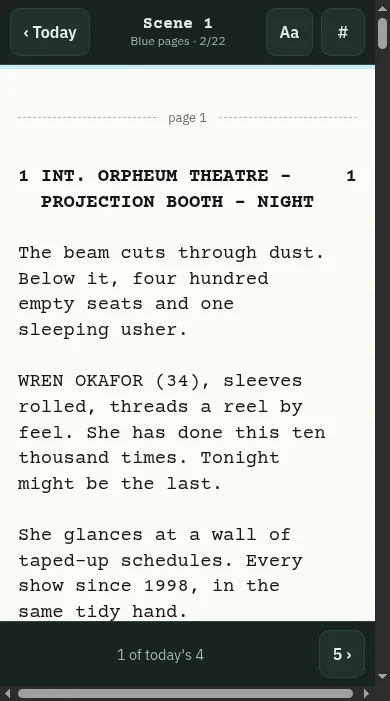
On the day, everyone opens On set on their phone: today’s scenes in strip colors, the day’s sides, and the script reflowed to a size you can read in the dark, kept on the phone for the basement with no bars.
One script, first card to last page
Nobody else carries a script the whole way. In Scrawl it never leaves.
- First cardAn idea on the corkboard
- The scriptTyped, page by page
- Out the doorContests, agents, producers
- GreenlightThe same script, now a production
- RevisionsBlue, Pink, Yellow pages
- On setToday’s scenes, on every phone
Bring every script you’ve got
Switching is safe. Bring your scripts from Final Draft, Fountain, PDF, Highland, Celtx and Word, title page and all; scanned PDFs are read too. Take them out the same ways whenever you like, today or in ten years.
Final Draft files go both ways with their title page, scene numbers and revision colors, because that’s the file studios, agencies and contests ask for. Pages are checked against Final Draft’s own prints.
Sign up By invitation, with a month free
In
- Final Draft (.fdx)
- Fountain
- PDF, typed or scanned
- Highland
- Celtx
- Word (.docx)
Out
- PDF, as it prints
- Final Draft (.fdx)
- Fountain
- Word (.docx)
- Breakdowns and schedules as CSV
Your script is never trapped here. Every export works on every plan, even after a plan ends.
Questions
Will my pages match Final Draft’s?
That’s the goal, and it’s checked against Final Draft’s own printed pages: the same margins, the same breaks, the same (MORE)s and CONT’Ds, so a 98-page script is 98 pages in both.
Does it work without a connection?
Yes. Keep writing on a train or a plane; Scrawl keeps your writing on the device and saves it once you’re back. On set, the day’s pages are kept on the phone.
Can I write with someone else?
Invite a co-writer to edit, a friend to leave notes in the margin, or send a read-only link to someone who doesn’t use Scrawl.
Does it do TV?
Series keep their episodes together with a shared bible of characters, and the breakdown works across the season. Multi-camera, stage plays and audio drama have their own layouts.
When does the Producer side open?
Early 2027. It’s built and being tested with real productions now.
What will it cost?
Prices come with sign-ups. Whatever plan you’re on, your scripts always come out with you.
Yours is next.
Scrawl is opening soon. Sign up and be the first to write in it.
Sign up By invitation, with a month free